For a business consultancy about EA and frameworks you would imagine we are fans of working groups. Intended for providing governance, communication, and situational awareness within any of your preferred EA methodologies, a working group should be at the heart of making your favorite framework an executional success.
However.
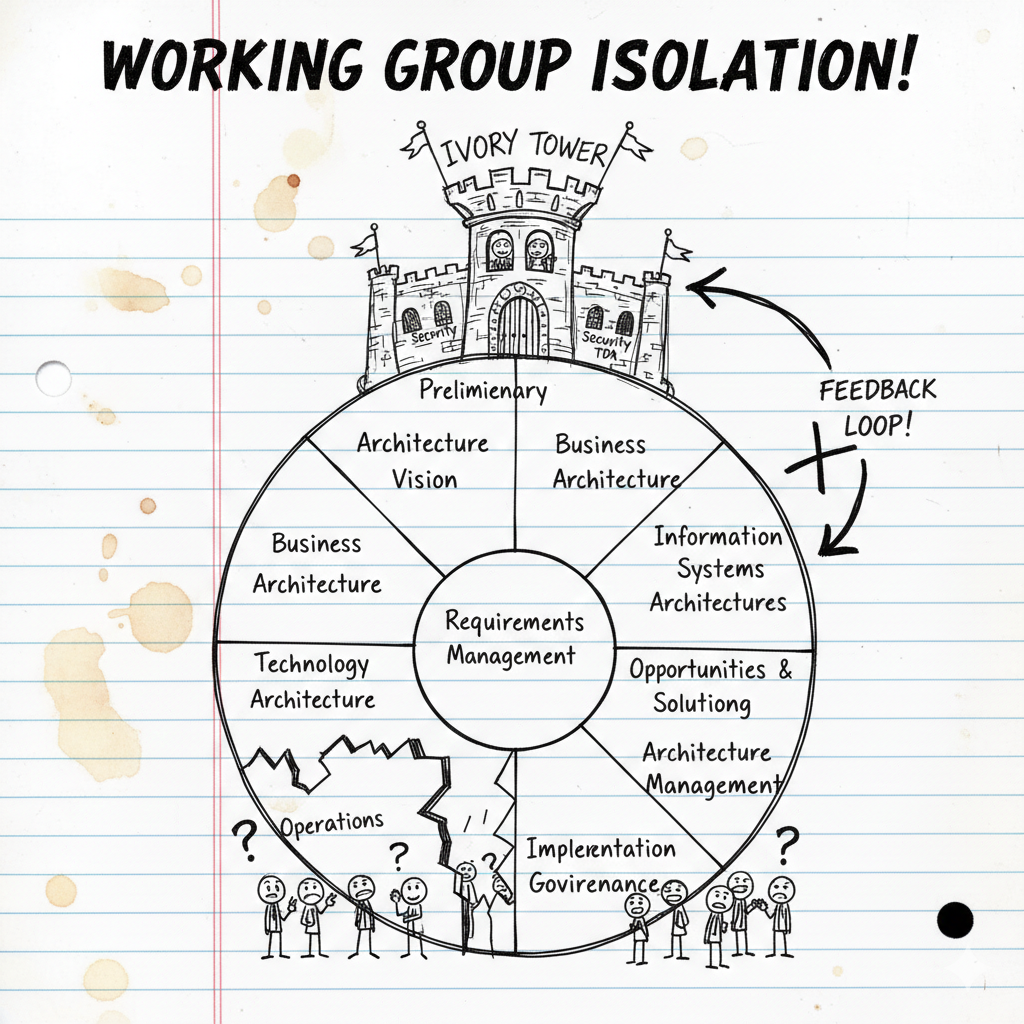
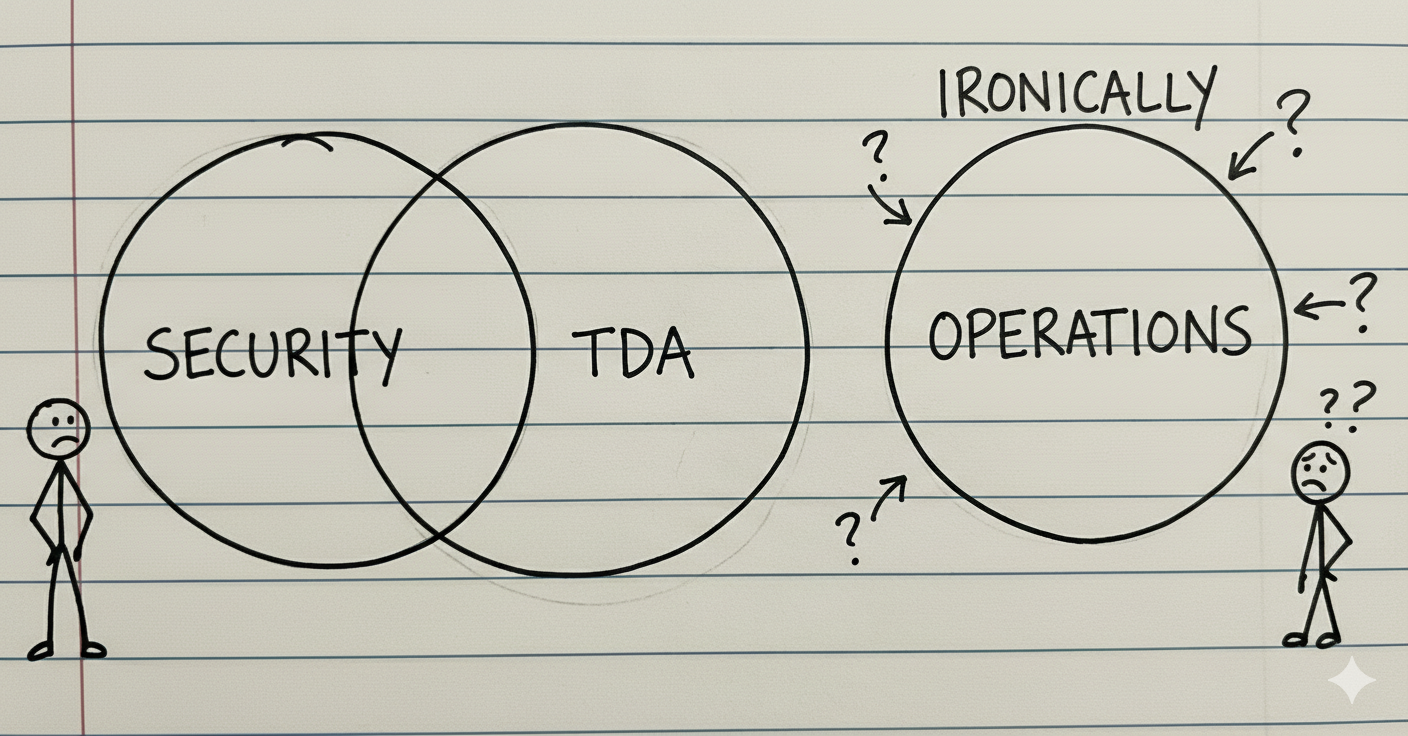
And I hate to be that guy. But painful experience has taught me that behind most working groups lies a classic organizational silo. For example, in many IT and engineering environments, the people who design the solution (TDA) and the people who protect it (Security) spend a lot of time in meetings together aligning standards. Meanwhile, Operations, the people who must keep the lights on and fix it at 3:00 AM are often left out of the loop until the very last minute.
The “Ivory Tower” Effect
Security and the TDA (Technical Design Authority) often focus on compliance and theoretical architectural theatre. They create the “perfect” blueprint. If Operations isn’t in that circle, the blueprint might be impossible to maintain in a real-world environment.
Thrown Over the Wall
When Operations sits in that isolated circle, it usually means they receive a finished product they didn’t help design. This leads to Operational Friction, with settings that are “secure” but break the functionality. Swiftly followed by LoD or “Lack of Documentation” with Ops being expected to support something they cannot fully understand, and yet they must. LoD is probably the most shameful aspect of modern digital transformation often lost to the whims of “it just works”, a topic for another time, I should probably write that down…
Back on point. A Venn diagram is probably not the best illustration, but it’s my article, so you’ll have to live with it. In essence you have a “working group” that is technically collaborating, but they are missing the vital feedback loop from the people running the actual hardware or software. This iterative feedback loop from all aspects of the ADM circle is critical; it doesn’t have to be linear; it can even be wagile! But crucially, it must have the mechanism to receive feedback and not act in isolation.
Which brings us to what this really is in modern circles, the DevOps/DevSecOps Gap.
The whole point of modern movements like DevSecOps is to force that “Operations” circle to overlap with Security and Design. If your diagram shows them standing alone, it’s a sign that the organization is still working in a traditional, fragmented way.
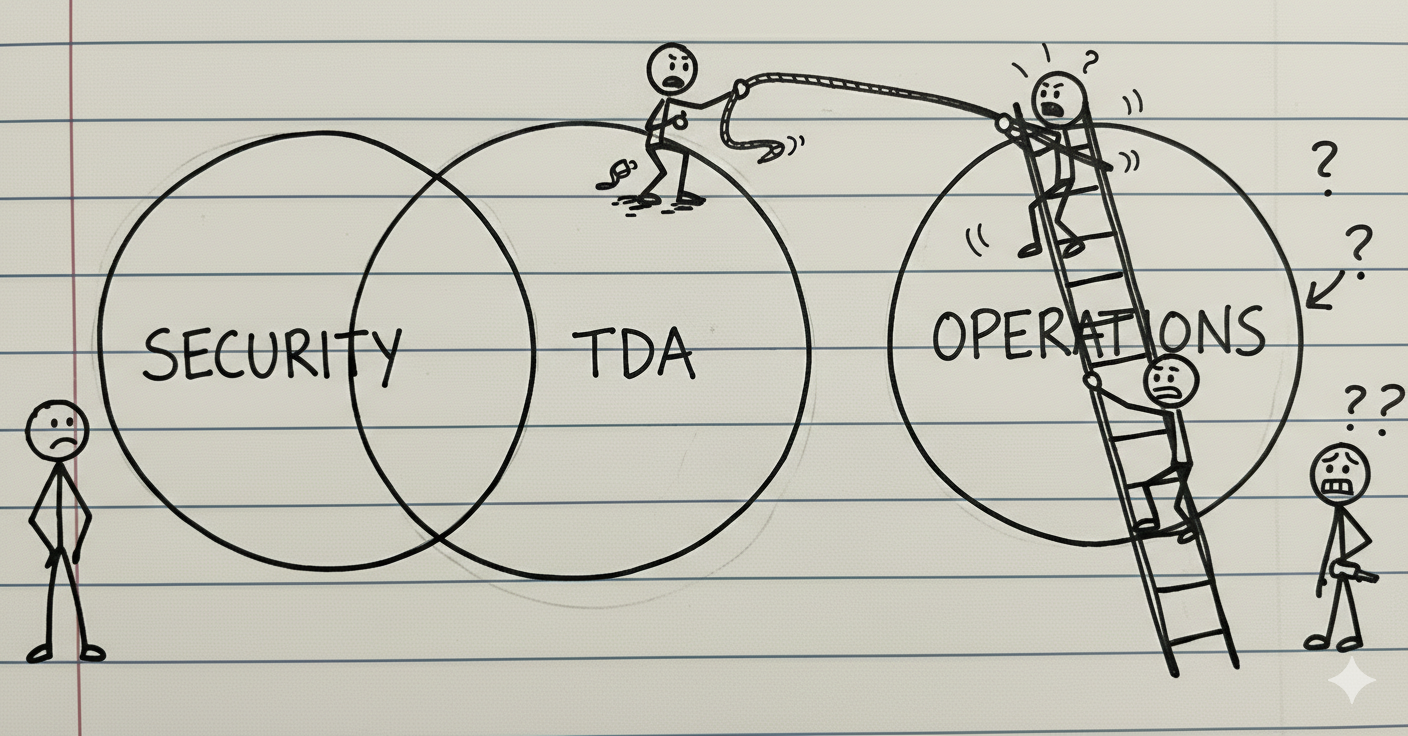
That gap between the “planners” and the “doers” is where most project delays and system outages live.
Iterative feedback loops for work groups are the key to avoid building isolated ivory towers. Crucially this is where the TOGAF ADM framework is such a powerful tool.
The ADM has endured since 1995 precisely because it recognizes that architecture is a living cycle, not a one-way street. If your working group is only focusing on the ‘top’ of the circle and ignoring the operational feedback of the ‘bottom,’ you aren’t governing, you’re just guessing and take it from me, that will hurt.